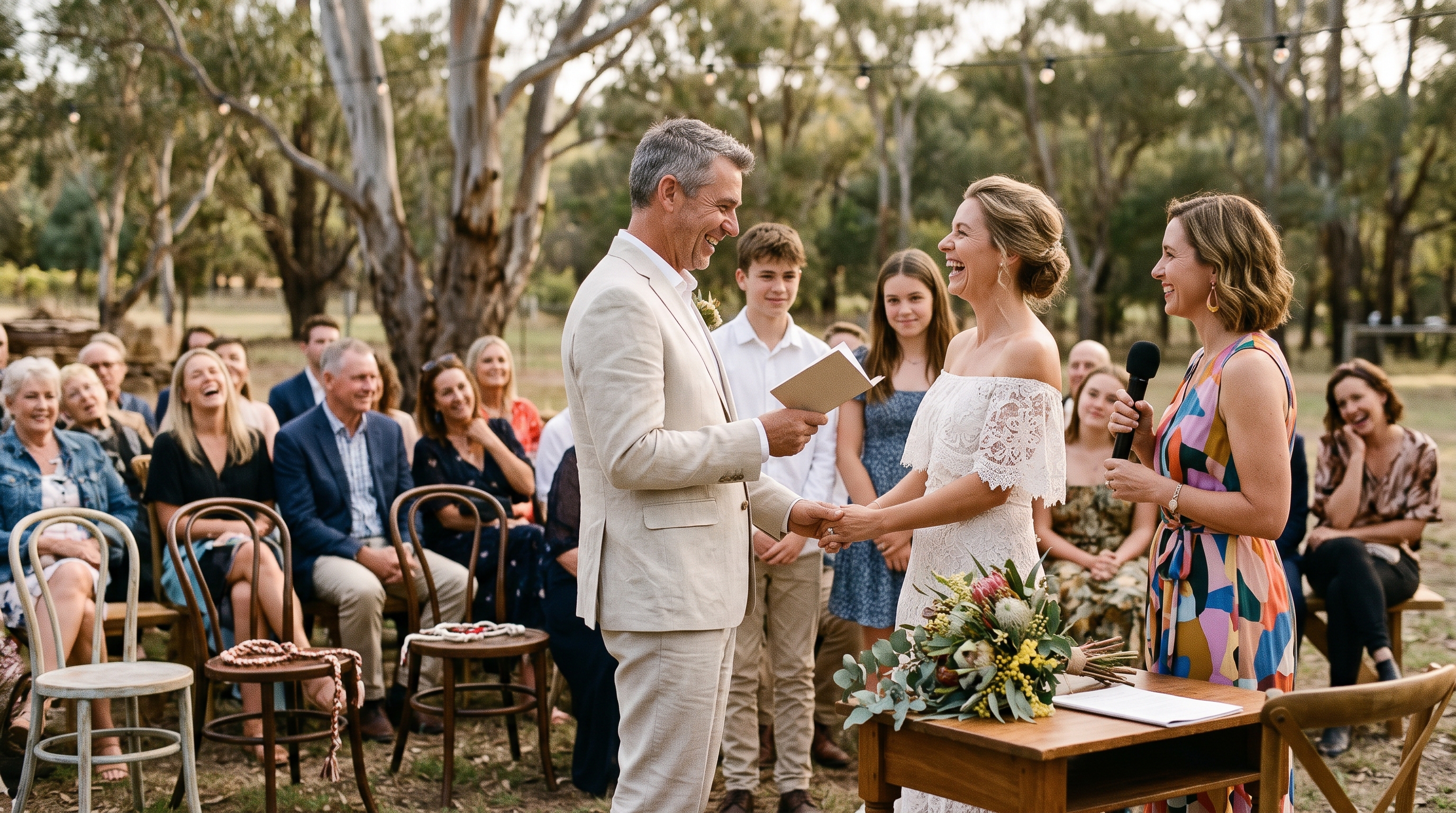
How to Personalise Your Wedding Ceremony | VITA Weddings
There's a moment in most first planning chats where one of the couple says, "We just don't want it to sound like every other wedding."
Good news. It doesn't have to. Once a few legal words are taken care of, almost everything else about your ceremony is up to you: how it starts, who's involved, how much of your story is told and whether people laugh, cry or (ideally) both.
This guide walks through how a ceremony is put together and the ways you can make each part your own.
The quick answer
To personalise your wedding ceremony, start with the legal essentials, then build around them with the things that make you, you. That might be a short version of your story, a reading that means something, a ritual with a reason behind it, or a role for the people who matter most.
In Australia, the legally required parts are small: your celebrant says certain words about marriage, you each say a short legal vow in front of at least two adult witnesses, and the paperwork is signed. Everything else is your choice.
What a wedding ceremony usually looks like
There's no fixed order beyond the legal bits, but most ceremonies follow a natural flow something like this:
Arrival and entrance. Guests settle, music plays, and one or both of you arrive. Who walks with whom is completely up to you.
Welcome. Your celebrant welcomes everyone and sets the tone. Some couples include an Acknowledgement of Country here.
Your story. A few minutes about the two of you: how you met, what you're like together, why you're here today.
A reading or a word from someone special (optional).
The legal words. Your celebrant says the words the law requires about the nature of marriage.
Your vows. The short legal vow, plus personal vows if you'd like them.
Ring exchange (optional, though most couples include it).
Ritual or family moment (optional).
Declaration and the kiss. The bit everyone's been waiting for.
Signing the paperwork in front of your two witnesses.
Presentation and exit. You're introduced as a married couple and head back down the aisle.
Most personalised ceremonies take around 20 to 30 minutes. A legal-only ceremony can be much shorter.
What's legally required (and what isn't)
This is where a lot of couples are pleasantly surprised.
Legally required:
An authorised celebrant.
Two witnesses who are over 18.
Your celebrant saying the words required by the Marriage Act about who they are and what marriage means in Australian law.
Each of you saying the legal vow, which includes your names and that you take each other as your lawful wedded spouse (there are a few accepted variations).
Signing the marriage documents.
Your choice:
Personal vows
Rings
Readings
Music
Your story
Rituals
Who walks you in, or whether anyone does
The "you may now kiss" moment
Knowing this takes a lot of pressure off. You don't have to include something simply because you've seen it at other weddings.
Making it personal: start with how you want it to feel
Before we talk about readings and rituals, I ask couples a simple question: how do you want people to feel when they walk away from your ceremony?
Some say "like they've had a good laugh." Others want a few happy tears. Most want a mix. That answer shapes everything else, from the words I write to how long we let a quiet moment sit.
It also helps to think about what you don't want. Too formal? Too long? Anything religious? Being kissed in front of your nan? All good things to tell your celebrant early.
Telling your story without making it cringe-worthy
This is the part couples worry about most, and it's often the part guests remember.
A few things that help:
Specific beats sweet. "The 2am cheese toastie that sealed the deal" says more than a paragraph about soulmates.
Keep it short. A few minutes is plenty. You're giving guests a glimpse, not a biography.
Let your personalities show. If one of you is always running late and the other has given up pretending otherwise, that belongs in there.
Include both of you. It's a story about two people, so give both sides a voice.
Leave out anything that needs an explanation, or that would embarrass someone in the front row.
Something couples don't always realise is that they don't have to write any of this themselves. Part of my role is asking the right questions, listening for the little details and turning them into words that sound natural when spoken aloud.
Choosing a reading
Readings are optional, and they work best when they mean something to you.
They don't have to be poems. Couples have used song lyrics (read, not sung, unless someone is very brave), a passage from a favourite book, a children's story, or a few lines written by a friend. The person reading it matters as much as the words, so think about who you'd love to hear from.
One tip: ask your reader to practise out loud, at least once, with a microphone if possible. It makes a big difference.
Rituals: include one because it means something
Handfasting, ring warming, unity candles, sand ceremonies, planting a tree, mixing a drink... there are lots of rituals to choose from, and social media makes all of them look beautiful.
The question I'd ask before including one is: why this one, for you two?
A ritual works when there's a reason for it. Maybe it reflects your heritage, brings your families together, includes your children or simply suits who you are. When there's meaning behind it, guests feel that. When it's there because it looked lovely on Pinterest, it can feel like a pause in the ceremony.
It's also worth thinking about who's involved, where it sits in the ceremony and how it's introduced, so it flows naturally and nobody is left wondering what's happening.
Involving family and the people who matter
There are so many ways to include the important people in your life, and they don't all involve standing up the front.
Parents or grandparents can walk with you, do a reading, give a blessing or be acknowledged during the ceremony.
Children can be part of the vows, the ring exchange, a family ritual or simply stand with you. For blended families, this can be one of the most meaningful parts of the day.
Guests can take part in a ring warming, answer a question together, or be asked to support you as a couple.
Loved ones who have died can be remembered with a few gentle words, an empty chair, a flower or a photo. This can be done warmly without making the ceremony sad.
This is an area where my broader ceremony experience comes in handy. Every family is different, and some dynamics need a bit of care. We'll talk it through so everyone feels included and you feel comfortable.
Your vows
You don't have to write personal vows. The legal vow is enough to be married.
If you'd like to add your own, keep them roughly the same length as each other, write them to be heard (short sentences help), and practise reading them aloud. And if writing them feels harder than you expected, ask for help. That's what your celebrant is there for.
Frequently asked questions
What order does a wedding ceremony go in? Usually welcome, story, reading, legal words, vows, rings, declaration, signing and presentation. Beyond the legal parts, the order is flexible.
What has to be said at a wedding ceremony in Australia? Your celebrant must say certain words about marriage set out in the Marriage Act, and you must each say a legal vow in front of two witnesses aged over 18. Your celebrant will take care of the exact wording.
Do we have to have rings? No. Rings are a lovely tradition, and the law doesn't require them.
Can our ceremony be funny? Absolutely. Humour works best when it comes from your real story and still leaves room for the meaningful moments.
Can we have a short ceremony? Yes. A ceremony can include only the legal essentials and still feel warm and personal.
How do we include our children? They could stand with you, hold the rings, join a family ritual or receive a promise of their own. It depends on their age and what they're comfortable with.
Let's create yours
You don't need to arrive with your ceremony planned. Most couples don't. Bring your ideas, your nervous laughter and whatever you know so far, and we'll shape it together.
Have a look at my [wedding ceremony packages] to see how much of your story you'd like told, or [let's talk about your wedding].
